


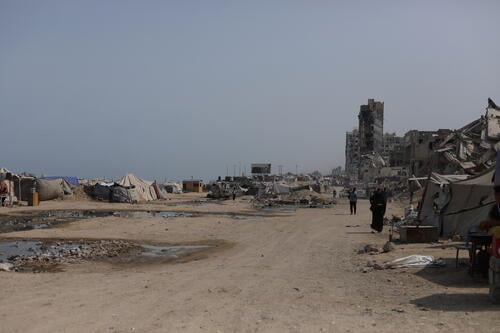
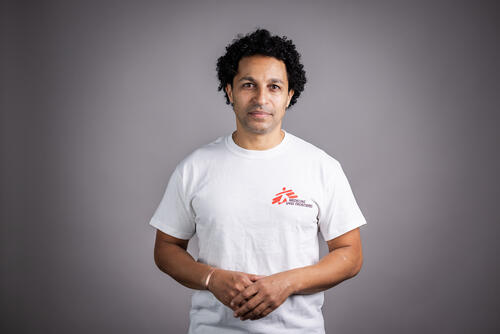
Dr Javid Abdelmoneim, International President of Médecins Sans Frontières (MSF), delivered testimony as part of the Gaza tribunal in Istanbul, Türkiye. The Gaza tribunal was put together by and for civil society organisations, so that they may pressure governments to act on people's sense of justice.
My name is Dr Javid Abdelmoneim. I am an emergency medicine physician and the Médecins Sans Frontières (MSF) International President. I was in Gaza, Palestine, from 6 June to 31 July 2024, as a medical team leader. My account today relies on that experience, as well as MSF’s work throughout the last two years.
Jury, please note that MSF is an independent medical humanitarian organisation. We deliver care to people affected by conflict, epidemics, and disasters—and we speak out about what we witness.
We have worked in Palestine since 1988. In Gaza today, over 1,000 of my Palestinian colleagues and around 40 international staff support hospitals, clinics, and water provision.
Jury, please consider that we bear witness to Israel’s deliberate mass harm to civilians, use of food as a weapon of war, and destruction of the healthcare system, as three key elements in its genocide in Gaza, which takes place in the historical context of the Israeli occupation, colonisation, blockade, and forced displacement of Palestinians across the Occupied Palestinian Territories.
Mass deliberate harm of civilians through killing and injury
During my time in Gaza, in the so-called safe humanitarian zone, gunships fired upon the coastline, while drones, helicopters, and jets were constant overhead; explosions shook our windows, and smoke plumes rose across the north, middle, and south simultaneously.
Over a span of just nine days in July 2024, I worked through four mass casualty events in the emergency room of Nasser hospital in Khan Younis. Four Israeli attacks resulted in 162 people killed and 568 injured, the figures recorded in Nasser’s emergency room (ER) alone. Two of those attacks were within the so-called humanitarian zone. One of those attacks employed a double tap method, whereby the first-responder medical teams who arrived on the scene were also struck. I treated those patients that day, many of them still in their ambulance and first-responder uniforms.
In the middle of one of those mass casualties, I saw our MSF anaesthetist in the emergency room instead of the operating theatre. He explained his house had been destroyed, and his daughters and nephews were in the ER somewhere. Later, we learned one of his nephews had been killed and another suffered a spinal injury and paralysis.
Within the next five days my nurse colleague’s son was killed living in the middle area, and another nurse colleague living in Gaza City had two children killed and his third severely injured, his wife survived with minor injuries.
Jury, please consider how the Israeli attacks were so indiscriminate, through disregard for civilians, that death became routine. Nearly every day, our wards echoed with the cries of my healthcare colleagues who were told that their family members had just been killed in their homes or while playing outside.
The Jury is invited to note one scene I experienced in Nasser’s ER during a mass casualty event, which captures a glimpse of the daily horrific reality in Gaza. A three-year-old girl injured, looking straight at me; she was breathing and alert. But when I removed the dressing, her entire left thigh was peeled down to the bone. Next to her, a woman covered in dust appeared stable—breathing, eyes open, no obvious bleeding—until I took down the dressing and a large piece of bowel emerged. A boy in his early teens, no facial hair yet, not breathing, dead on the floor. A man with most of his lower leg mangled. A boy with his face almost entirely burnt. A woman whose entire back is burnt with shrapnel and melted clothing. A girl taking her last breaths, alone. At least she was on a bed. These are just 7 people of the 730 in nine days at Nasser alone, more than a year ago, and the same violence has continued every week there has not been a ceasefire.
Members of the Jury, I would also like you to consider that during my time in Gaza in June 2024, the Nuseirat hostage rescue produced catastrophic civilian casualties – something I witnessed with my own eyes. The disproportion between the four Israelis rescued and the nearly 980 Palestinians killed and wounded that day is an affront to humanity. The entire trauma system was overwhelmed from middle area to south. In our trauma unit in Nasser alone, we took in 19 patients transferred from Al-Aqsa hospital. The last child admitted from that attack was discharged 42 days later from our ward. He suffered an amputated forearm, a brain injury with memory loss and seizures, and still had a metal external fixator attached to his femur.
Less than a week after that rescue, as we waited to cross the Netzarim corridor, I witnessed the murder of two fishermen on the beach, roughly two kilometres from the buffer zone, each killed by a single shot from behind as they ran away, one to the neck and one to the heart. Israeli authorities denied us permission to render first aid or retrieve the bodies; their friends carried them away, one still clutching his fishing net.
How Israeli authorities used food as a weapon of war
The deliberate use of food as a weapon in Gaza saw hunger reach unprecedented levels, with famine confirmed by the IPC1 on 22 August 2025. This is not hunger – it is deliberate starvation.
At the MSF clinic in Gaza City, in the north of the Strip, the number of people enrolled for malnutrition treatment by the second week of July 2025 had quadrupled since mid-May, while rates of severe malnutrition in children under five tripled in two weeks of July 2025 alone. In Gaza City, as of 9 August, MSF had 1,599 people enrolled as outpatients for malnutrition, 42 per cent (672) of these patients were children under five years old. Over half were pregnant and breastfeeding women.
A week-long survey at our clinics in Gaza this July showed a quarter of pregnant or breastfeeding women and children were malnourished. Our four outpatient feeding centres were overwhelmed, facing demand driven by deliberate starvation.
Members of the Jury, during this time, people were forced to seek food at the Israeli- and US-led militarised food distribution sites run by the so-called Gaza Humanitarian Foundation (GHF). Distributions at GHF sites were accompanied by extreme violence; Palestinian men, women, and children seeking food came under fire from Israeli soldiers and from American security contractors.
Our teams on the ground treated people with gunshot wounds, barbed-wire lacerations, and crush injuries from stampedes, all sustained while trying to receive aid at GHF sites. Between 7 June and 24 July 2025, in just two of our facilities, we received 1,380 injured individuals and 28 dead from two GHF distribution sites. The anatomical precision of many injuries suggests intentional targeting rather than indiscriminate fire. This is only a fraction of the total injured and killed seeking food aid at GHF sites– just the patients we saw in our own clinics.
Esteemed Jury, our colleague Abdullah Hammad was killed on 3 July 2025. Israeli forces deliberately targeted a group of people, including Abdullah, without warning, as they waited for aid trucks to collect flour in Khan Younis.
Jury, we highlight that famine and deaths at food aid sites were not accidental; they were deliberately orchestrated by Israel.
On the deliberate destruction of the healthcare system
Medical facility closures and direct attacks on health infrastructure
In the space of eight days in July, while I was in Gaza, Israel’s evacuation orders resulted in the closure of 13 medical points, four primary healthcare centres, and three hospitals. This included our MSF Gaza City Clinic medical point, one of the only functioning clinics for wound care in the north, and the Ministry of Health’s European Gaza hospital in the south. This last closure resulted in an influx of patients to Nasser hospital, where I worked. Families wheeled their injured loved ones still on their hospital beds from hospital to hospital to try to get them care.
From October 2023 until September 2025, MSF evacuated staff and patients from 24 health facilities. We have endured over 50 violent incidents, including airstrikes on hospitals, tank fire on deconflicted shelters, and attacks on convoys.
On 25 August this year, Nasser was targeted once again in a double tap airstrike. It is the only functioning public hospital in southern Gaza. The attack killed 21 people, including healthcare workers and journalists. One MSF colleague sustained injuries to his chest. The Jury should consider that Nasser is just one of many hospitals repeatedly hit.
Since 9 August, there is not a single fully functioning hospital in Gaza; currently only 14 of 36 are partially operational.
Systematic obstruction of medical supplies & equipment
Immediately following the Rafah invasion in early May 2024, medical supplies arriving from outside became minimal to non-existent. As MSF in Nasser, we ran out of ibuprofen, even wheelchairs and crutches; we had to borrow surgical gowns and lacked enough mattresses for beds in the MSF burns and orthopaedic trauma wards. The Jury should consider that in the first seven days of July 2024, health services received less than nine per cent of fuel needs. This triggered electricity rationing that at times meant no water on the wards until 2pm, no electricity in inpatient areas, no sterilisation services, and repeated power limits in operating theatres. At a time of influx of wounded from mass casualties, for example, six surgeries had to be cancelled in a single day because surgical staff could not work without electricity.
Dear Jury note that Israeli procedures for authorising and managing the entry of essential supplies into Gaza were, and continue to be, inefficient, arbitrary, and marred by blockages and delays. Only two-thirds of our requests have been accepted since October 2023. Average response times in two years are 83 days for medical items and 64 for logistical. Some items took over 300 days. These obstructions prevented life-saving surgery and care; last year we recorded 18 per cent wound-infection rates in six of our clinics.
Healthcare workers systematically targeted
Over 1,700 healthcare workers have been killed since October 2023. At MSF, 15 Palestinian colleagues have been killed by Israeli forces in Gaza. Moreover, our colleagues were displaced multiple times, starved, and maimed.
Dear Jury, take note that Drs Mohamed Abu Nujaila and Ahmad Al-Sahar, MSF doctors working in Al-Awda hospital were killed when the facility was struck in November 2023. We had repeatedly informed Israeli authorities that Al-Awda was a working hospital with patients and medical staff and therefore protected under international humanitarian law. A few days earlier, our colleague Alaa Al-Shawa, a nurse, was killed when a clearly marked MSF convoy came under attack in Gaza City despite having authorisation to evacuate. He was shot in the head.
Two years of Israeli raids on hospitals has resulted in arbitrary detention, torture, and forced disappearances of health workers, including MSF staff. On 26 October 2024, during a raid on Kamal Adwan hospital, MSF surgeon Dr Mohammed Obeid was arrested with 57 others. To this day he remains in an Israeli prison without charge, cut off from his family, and has lost significant weight.
Destruction of the water & sanitation system
Beyond the healthcare system itself, Jury please be mindful that the water and sanitation system, integral for public health, has been destroyed by Israel. In July 2024, a UN assessment of the water and sanitation system revealed over 100 kilometres of the sewage network and 60 per cent of the sanitation system destroyed, including the totality of all heavy machinery needed to manage solid waste. Less than a third of the fuel needs for desalination pumps and water trucks were allowed by Israel that month.
This all, coupled with serial displacement and breakdown of vaccination programmes meant that polio was declared in Gaza, while I was there. It had been eradicated years previously. In our clinics, top diagnoses were water- and sanitation-related— diarrhoeal, skin and eye infections—because people lacked clean water, toilets, soap, and disinfectants.
Members of the Jury, a health system does not collapse by chance; it is destroyed when hospitals are deliberately attacked, supplies are choked off, healthcare workers are killed or detained, and the water & sanitation system is ruined. As Gaza’s health infrastructure has collapsed, civilians are left without lifesaving care. Patients with trauma injuries, chronic diseases, cancer, communicable illnesses, and malnutrition are dying from preventable causes. I ask you to recognise this for what it is—the deliberate dismantling of the means to survive.
Conclusion
Deliberate mass harm to civilians; food as a weapon of war; destruction of the healthcare system.
Under these headings, I have described Israeli actions that, in our witnessing and experience, reflect a systematic and deliberate pattern of destruction targeting the people of Gaza. These actions, taken together, suggest intent to destroy, in whole or in part, the Palestinian people—what we believe, as others do, constitutes genocide.
I welcome the ceasefire and hope it will last. For now, it has paused the violence, but the genocide is far from over: aid is still not flowing at scale. A humanitarian catastrophe continues to unfold, and there remains an urgent need for credible accountability mechanisms to deliver justice for the thousands killed and injured by Israeli actions over the past two years.
Thank you.
Gaza-Israel war
MSF statement on staff registration and the continuation of medical care in the Occupied Palestinian Territory
Statement
24 Jan 2026
Gaza-Israel war
Addressing frequently asked questions and allegations about MSF’s work in Gaza
Project Update
16 Jan 2026
Gaza-Israel war
Israel’s threat to withhold NGO registrations is a blow to humanitarian aid
Statement
2 Jan 2026