


This story was first published in The Guardian by Ella Baron.
Almost four years since the escalation of the war in Ukraine, the toll on people remains high. Every day, Médecins Sans Frontières teams working in Vinnytsia and Cherkasy are seeing this impact, while providing rehabilitative and mental health care.
We invited Ella Baron, an illustrator based in the United Kingdom, to visit our projects in Vinnytsia and Cherkasy so that she could use drawings to capture things that are, as she says, “beyond a camera’s reach”. Below are testimonies and their accompanying illustrations, taken in May this year and shared by Ella Baron.
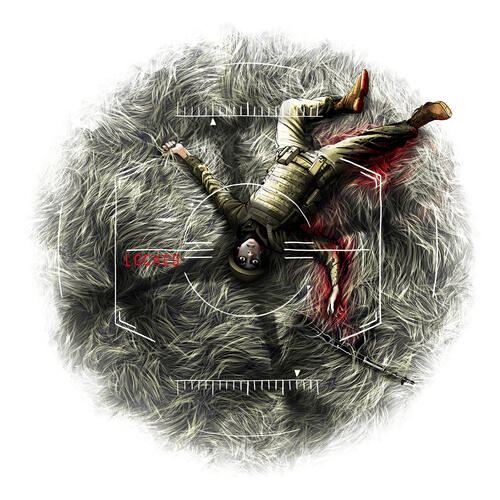
Dima
When Dima regained consciousness in the hospital he’d phoned his mother to tell her that “everything was fine- just a few scratches”.
“It wasn’t true,” he tells me. “There was a big hole in my leg and in my ear and arm.”
He still can’t sleep.
“My nightmares are always the same; they’re taking me from the hospital back to the trenches- and then I am above- I am the drone making the projectile drop that hits me,” says Dima.
Dima flies first person view (FPV) drones so he knows how this looks.
His psychologist tells him he might sleep better if he wasn’t on his phone all night. But he likes watching videos on Instagram and Youtube; mostly bodycam footage of the war that, he explains, help him to understand the ‘subtleties’ of his own memories. What he did; what he could have done. He tells me about his mentor, Matrovski, who made Dima stay down in the trench whilst he looked out to see if the Russians were still there. Matrovski was immediately shot in the neck and bled to death.
The shard of shrapnel that had buried itself in Dima’s body when the drone projectile detonated is now sitting on his bedside table.
“It momentarily paralysed me from the bottom of my spine to the end of my extremities,” he says. “I thought it had injured my spinal cord, and I wouldn’t be able to walk. I thought this is the end. But I started to touch my head to see if I had any blood. I didn’t find any and I said to myself I am alive I am not dead.
“I could hear the enemy drones watching,” Dima continues. “FPV’s have a horrible squeaky sound- like Formula 1. If it’s high, then it’s quiet. When it gets louder, then you worry. I could hear them watching so I lay very still and pretended that I’m dead. I heard them leave because they thought I was dead. Then I was screaming from the pain. I thought I would bleed to death.”
He tells me that he’d survived because, “I am my mother’s only child. When I joined the army, she had cried and so I’d promised her that everything would be fine.”
Dima tells me his mother is a kindergarten teacher, “the kindest person in the world. Always smiling- even when she’s sad. She has brown hair and green eyes like mine.”
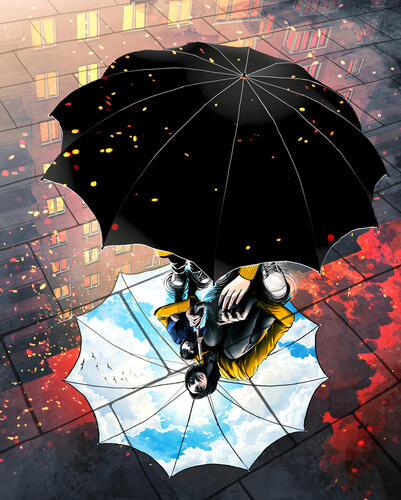
Olena
When I ask Olena where home is she tells me about the clouds in Luhansk.
“They’re really beautiful, like mountains because there aren’t any tall buildings there,” she says. “Home is where the sky has no missiles- just clouds and the sun and birds and planes- but not military, safe with passengers. The most important thing is the feeling that you can look at the sky without being scared. Because after 2022, I had to again learn how to look at the sky without fear.”
The first time Olena was displaced by conflict was in 2014, at the age of 19. She ‘got on a train to nowhere’ and wound up in Kyiv, searching through old Facebook friends for somewhere to stay. She rebuilt her life in Luhansk
“I loved that flat…The children’s bedroom had pastel wallpaper with balloons….my husband and I built a big balcony- and I pasted these stickers of pink peonies and all over it,” she says. “We had a great life; we didn’t expect to have war… even more war. Then we started hearing explosions from the frontlines…then we saw the first missiles in the sky, interceptions- the children were terrified.”
When the invasion happened, Olena and her family fled to Vinnytsia.
“I feel like I have two lives. Part of my soul is left there back in that life,” says Olena. “So, I’m here, but at the same time I'm there.”
When I ask her what she hopes for the future she says, “I don't see the future, for now. I live in the present day…I just think ‘I woke up in the morning, thanks God, I went to work; thanks God. My children went to school, God thank you.’”
She has portraits of her children tattooed on her arms. She shows me her other tattoos too- a mandala, a daisy with a plaster, and birds.
“They’re all connected to the war…they’re like scars,” she says.
I show her my tattoos, and some of my drawings. Olena likes drawing too. She shows me a photo of one of her paintings - a road leading to a little house on a hill covered with bright yellow wheat. The sky is dark blue, because, Olena says, “it’s stormy, like it’s about to rain”.
She points to the single lit window of the house. “I added this to be like hope,” she says.
I ask if this drawing is of a real place that she’s lived. But she says, “no- an abstract place- a home in the heart”.
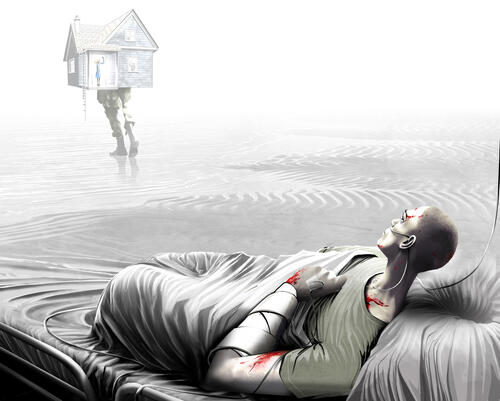
Roman
In 2022, Roman quit his job as a parcel collector and joined a medical brigade to collect injured and dead soldiers. He says that, “sometimes the body parts were blown up into the trees”.
When the drone detonated, his legs didn’t get that far. They ended up in the box next to him at the medical stabilisation centre, still in their shoes.
“I remember looking at my legs in the box, separate from me,” says Roman. “I was so scared when I realised that I couldn’t get this part of my past back, that my future would be very different. I was so sad to say goodbye to what was in the box... Then I realised that it was too early for me to die. I hadn’t said goodbye to my family or finished building the house for them.”
When Roman started building the house almost twenty years ago, he went to the bank to take out a loan from a very beautiful woman with white-blonde hair.
“I told her all about the house, and she said, ‘Maybe one day you’ll show me’. I took her number and invited her for coffee,” he says.
Roman and Tania married soon after and now have two children: Oleksii, who is 12, and Ivan, who is 21. Their house is finally almost finished – white pillars and blue walls – with only a few tiles on the roof left to complete, and maybe a swimming pool too. Roman tells me how his family loved to go swimming in the sea in Odesa.
“We used to go all together, but if I imagine going back, there's one thing I can't understand: how will I be able to go in the sea?” he asks. “Can you swim with a prosthesis?”
I don't know the answer to that, but after a long pause, Roman does: “My eldest son Ivan goes to the gym. His muscles are even bigger than mine. He can carry me on his back into the sea. I'll swim with him. Then he’ll take me back out of the water, put me on the chair, and I’ll put my prosthesis back on. That’s how it will be.”
Roman says he called his wife from the hospital to tell her that he’d lost his legs, but to not worry as everything is fine and nothing has changed.
“I don’t want anything to change,” he says.
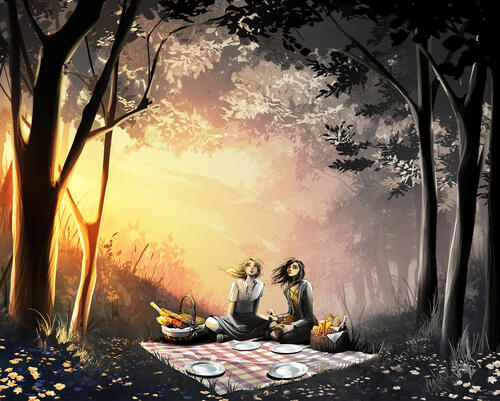
Inna and Tetiana
Inna and Tetiana came to talk to me together. They exchange glances before every answer, tissues and whispered encouragements. Tetiana’s son, Valeria, and Inna’s husband, Mykola, are both prisoners of war in Russia. They were captured on the same day in May 2022. Valeria is 27 now. Inna struggles to remember her husband’s age. She says it’s because, “we don’t celebrate birthdays anymore. When they were captured, everything stopped”.
But when I ask what Valeria and Mykola look like, Inna answers, “now or before?”
Inna and Tetiana wait at every prisoner exchange in the hope that their relatives will be amongst those released. When they’re not, sometimes the soldiers who are bring back news of them. That’s how Inna and Tetiana know how different their relatives look now – “exhausted, so thin”.
For the first year of her husband’s captivity, Inna struggled to eat. She says she’s a bit better now; she’s found Tetiana.
“We have the same pain, we understand it,” says Inna.
Both women believe that they have a “spiritual connection with their loved ones”, that they “must stay strong and cry less so they may also feel our hope and prayers”.
Inna describes how her husband comes to check on her in her dreams.
Inna tells me she likes to picture sitting with her husband in their garden back in Mariupol. Mykola liked to grow flowers there
“Wild forest flowers- I don’t even know where he got those seeds,” she says. “At the time, I didn’t even like them! But now nothing would make me happier.”
Tetiana says she also likes to picture Valeria.
“Somewhere in nature…a field of white chamomile with the sun shining really bright…bird song, fresh air,” she says.
Neither Inna nor Tetiana have had any direct contact with their relatives for three years. If they could talk, Inna tells me she’d say, “that I love him- that we’re waiting”.
“We’re waiting,” Tetiana adds. “We’re definitely going to wait.”
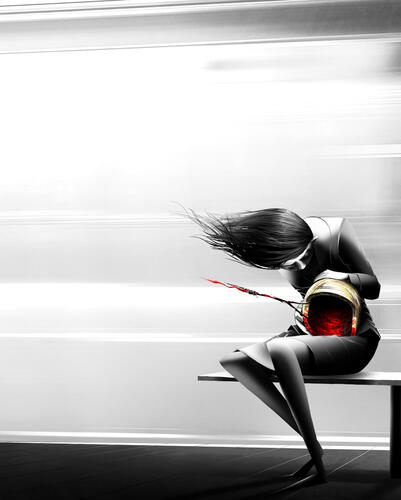
Tetiana
Tetiana cries silently throughout our conversation. She says she doesn’t want to stop or skip any questions; she always looks me directly in the eye. Her son Maksym was born in 1995, the same year as me. He was killed during fighting in Donetsk on 8 May 2022.
“It’s not possible to describe the burden of the pain I’m bearing,” says Tetiana. “I think about him every God’s day; when I wake up, when I go to sleep. Sometimes when I’m walking and I see a young man that resembles mine- tall, gentle, strong- I think, like, ‘oh, because I had once such a boy’.”
She says that her grief is, “like the evening sky, like twilight- there’s still some light there, and the light is all Maksym”.
Tetiana was born in Russia and came to Ukraine in 1974. She tells me that they’re a railway family and that she worked there for 40 years.
“It’s where I met my husband,” she says. “We wanted Maksym to join the railway too, but even from his childhood he always dreamt of joining the military.”
When he was a boy, Maksym used to play Zarnytsia in the woods. It's an old Soviet war game. The name translates from Russian as 'heat lightning'.
“This is how he will remain forever for me- running through the woods,” says Tetiana. “There’s a photo of his dead body which his commander took. I still haven’t looked at it. I can’t. Let him remain alive for me, for the rest of my life.”
She tells me that he was, ”always a military man- he loved his country”.
But he was gentle too. In the trenches, he’d feed the lost cats and send her photos of them. She says he’d call to say, “‘Mum don’t worry; everything’s going to be fine’”.
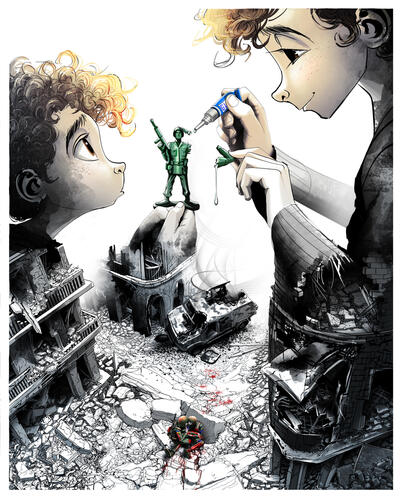
Petro and Dmytro
Petro says he and his older brother, Dmytro, “have been making little models of soldiers together since childhood, and conducting fake wars.”
“Then we grew up and had a different kind of war,” says Petro.
“In the war, we were always together,” says Dmytro.
They were together when the drone detonated under their car, killing the other two soldiers with them. The brothers are now recuperating from their injuries in the same hospital, in different wards. I talk to them separately, but each brother tells me mostly about the other.
Petro says that when the drone detonated, “I felt a very strong burning sensation, and I was screaming. My brother was screaming that he was injured too, and I was so happy that he was screaming because it meant he was alive.”
“I heard my brother’s voice, and I calmed down,” says Dmytro. “It probably all happened very quickly, but it felt like time stopped. When I realised that Petro was seriously injured in all four limbs – how much blood he was losing – I knew that I had to provide medical aid for him, or he would die.”
“I’ve been on the frontline for a long time,” continues Dmytro. “I’ve tied a lot of tourniquets. So, in this situation I’m not panicking. I’m calm. I tied the tourniquets. But I was worried about him.”
Petro says Dmytro worries too much, “but it’s natural, I’m his little brother”.
“I’ve been protective of Petro since picking him up from kindergarten,” says Dmytro. “He’s not weak, he’s very strong. But I have to look after him. He’s my little brother.”
They are now healing well, although Dmytro says he’s worried about Petro’s hands. His doctors say he’ll never regain full movement. Dmytro says his brother has “golden hands: whatever he likes to do with them, he does so well”.
“He’s very creative: a sculptor, he plays the guitar,” he adds.
Petro says it was Dmytro’s guitar – his brother bought it but got bored after learning one song and quit, so Petro learned to play instead.
Petro hopes the war has left him with enough movement in his hands to go back to making sculptures, and there’s one sitting on his bedside table in the hospital. It’s a phone stand with the insignia of his village’s brigade, which he insists on giving to me. I’m concerned that without it Petro won’t be able to hold his phone, as one hand is swathed in bandages and the other sutured to his midriff.
When I ask the doctors about this they explain: “To encourage the skin grafts on his hands to take, we connect the hand to the midriff where the blood supply is better.”
They say Petro spends a lot of his time on his phone, mostly video calling Dmytro in the hospital ward downstairs.
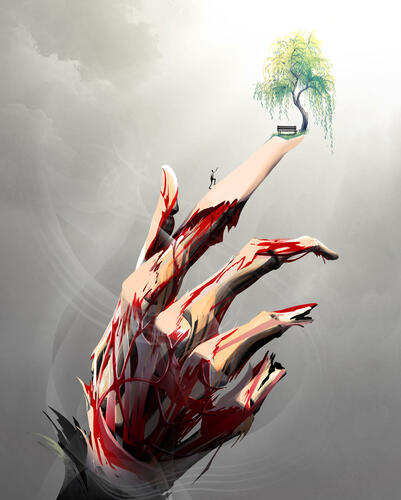
Valentyn
It was a rainy dawn, and Valentyn had been sweeping for mines; dawn so as not to be seen, rain because it makes it harder for the drones to fly. He tells me that he never touched the mine- it reacted to the electrical magnetic field of his body with a flash that weeks later, he still can’t get out of his eyes. He holds up the bandaged stumps of his arms.
“For this hand there is no hope,” he says. “But for the other - one finger is still alive.”
He shows me the prosthetic he’s been given to hold a spoon.
“The next device must be to hold a fishing rod,” says Valentyn.
With his one remaining finger, Valentyn mimes reeling in a fishing line. Valentyn’s grandpa taught him to fish- he still goes to that same spot on Dnipro river.
“It’s very beautiful- very calm,” he says. “Just trees by the river. I like to go there alone. If I go with my friends, they get drunk and scare away the fish.”
When I ask the soldiers to describe what peace means for them, so many of them describe ‘calmness in nature’. The places they want to return to are their gardens, parks and forests.
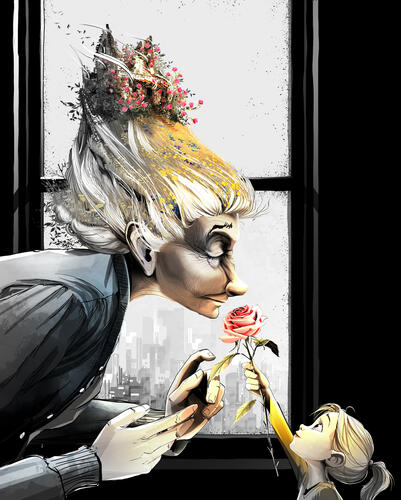
Natalliia
I meet Natalliia at a women’s support group in Vinnytsia for refugees from Kherson. Today, they’re making flowers out of colourful pipe cleaners. The windows of the community room are filled with flowers that Natalliia grows in little recycled pots.
She tells me about her garden, back in Kherson, where she lived before the invasion. 200 square metres, filled with apricot trees and grape vines and flowers; her favourite were the pink roses. She shows me photos that a friend who stayed behind took recently. Their house has been utterly destroyed - but the roses in the garden are still blooming.
Now Natalliia lives with her family in a small apartment in Vinnytsia.
“There’s no garden but a good window,” she says. “For my birthday I was given a huge bouquet, and there were still some roots! Now I have seven big bushes in water on the floor in front of the window.”
She says her family think she’s mad, apart from her 9 year old granddaughter, Anya- who also has green fingers. Anya’s father, Natalliia’s son, always buys her flowers from the supermarket when he comes back from the front.
“The flowers are like a memory from home,” she says.
“Peace is the memory of the life that we were living there,” says Natalliia. “Here, we are just waiting… my soul is in the garden back home in Kherson.”
As Natalliia talks, the other women have been twisting their pipe cleaners into flower ornaments. Svitlana, also a refugee from Kherson, has hands that tremble so violently that Natalliia helps her with the fiddly bits. When I tell her about this [illustration] project she says, “no picture could capture what we have lived through”.
“What it is to have everything, to be together with all your family in your home, and then be living by the side of the road,” says Natalliia.
It’s a fair point.
MSF activities in Cherkasy and Vinnytsia
Since February 2022, the full-scale war in Ukraine has triggered a dramatic increase in the number of people in Ukraine with long-term injuries requiring complex care. This includes individuals with blast injuries, shrapnel wounds, and amputations, all of whom require intensive, specialised care, placing extra strain on the country’s health system.
In response, MSF launched an early rehabilitation project at Cherkasy hospital in central Ukraine in March 2023. This project provides physiotherapy, psychological support, and nursing care to address the complex needs of patients wounded in the war early in their recovery process.
Mental health is also central to the care that MSF provides in Ukraine. In 2023, MSF began offering specialised psychotherapeutic services to people showing symptoms of war-related post-traumatic stress disorder (PTSD) in Vinnytsia. A custom-designed mental health centre opened in September 2024. In this centre, MSF offers one-to-one psychological sessions, as well as sessions for members of patients’ support networks. We also provide patients with techniques to help reduce symptoms, increase coping skills, and decrease the consequences of traumatic stress.
In addition, our Vinnytsia team also provides evidence-based treatments for war veterans who have been wounded or demobilised, and are readjusting to civilian life, as well as for their relatives and families, and for displaced people affected by the war. The centre uses therapies such as Eye Movement Desensitisation and Reprocessing (EMDR) to help patients process traumatic memories and alleviate PTSD symptoms.
Ukraine
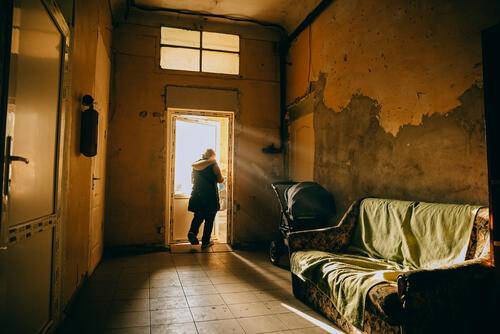
What four years of full-scale war has taken from people in Ukraine
Project Update
19 Feb 2026
Ukraine
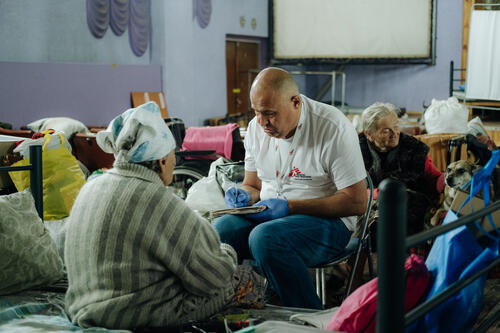
Displaced people struggle in eastern Ukraine’s overcrowded shelters
Project Update
2 Oct 2025