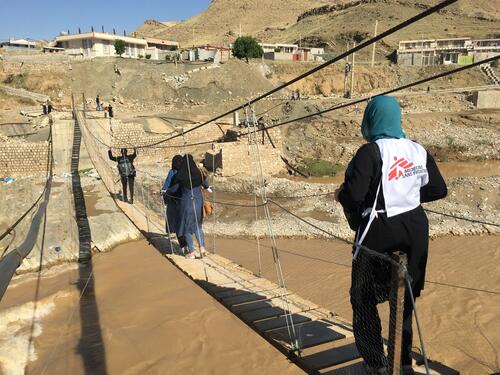
After the floods in Iran, providing health care to the vulnerable populations in Lorestan
An MSF medical team crosses Kyan Abad rope bridge to reach Paran Parvis village. Iran, May 2019. 
© Sacha Petiot-Smigieski/MSF

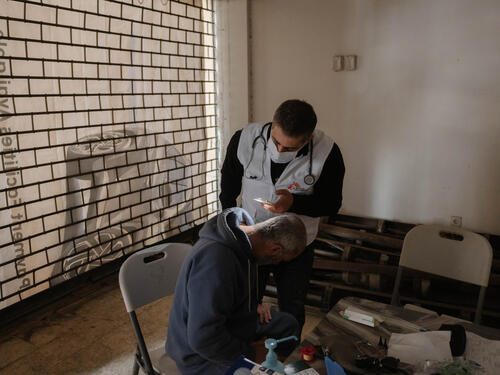
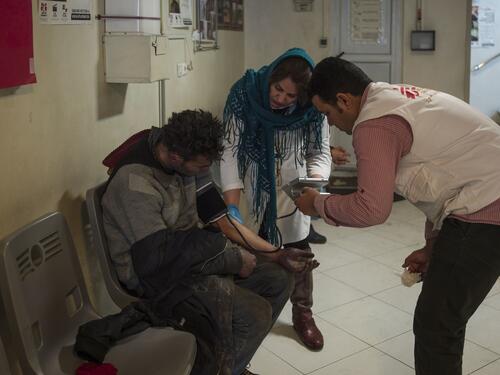
We provide free healthcare to excluded and marginalised people, and Afghan refugees in South Tehran, Mashhad and Torbat-e Jam. Our services include general healthcare, nursing care, mental health support, and treatment and referrals for hepatitis C and B, HIV, syphilis, and tuberculosis. We also provide maternity services.

Our activities in 2024 in Iran

Data and information from the International Activity Report 2024.

MSF in Iran in 2024 In Iran, Médecins Sans Frontières (MSF) runs programmes to assist marginalised groups who often face barriers when seeking healthcare, including refugees, migrants, people engaged in sex work, and people who use drugs. 
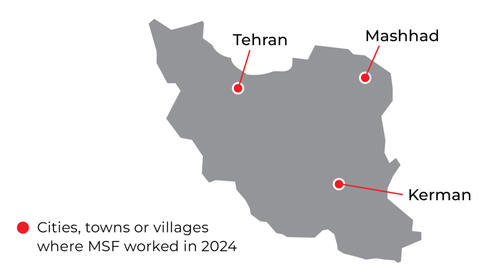
Iran IAR map 2024
Country map for the IAR 2024.
© MSF

The UNHCR estimates that there are around 4.5 million displaced people of varying statuses in Iran. Among them are 2.6 million Afghans, of whom only 750,000 are officially registered as refugees.[1] Although most of them live in urban settings, refugees and migrants experience difficulties in accessing medical services due to stigma and exclusion.

In South Tehran, we run a project offering hepatitis C testing and treatment in a drug rehabilitation camp for men. We also provide basic healthcare for Afghan women, with a focus on sexual and reproductive health, through a facility in the Darvazeh Ghar neighbourhood and mobile clinics. Our other activities include nursing care, mental health and social support, and referrals for specialist healthcare and other services.

In Mashhad, Iran’s second-largest city, located near the border with Afghanistan, we conduct medical consultations and screening for infectious diseases through mobile clinics. Counselling, social support, health education, and referrals to specialist health facilities are also available at our clinic in Golshahr district, where most of the Afghans in the city have settled.

In Razavi Khorasan province, we offer mental health support and treatment for hepatitis C to people who use drugs in rehabilitation centres in Torbat-e Jam’s ‘Guest City’, a government-run refugee settlement.

Further south, in Kerman city, we started providing basic healthcare and referrals for specialist care exclusively for Afghan refugees and migrants.  We are also rehabilitating three health facilities to improve access to basic healthcare services for newly arrived and unregistered Afghan refugees.  


In 2024