Maternal and neonatal health in Couffo

Benin

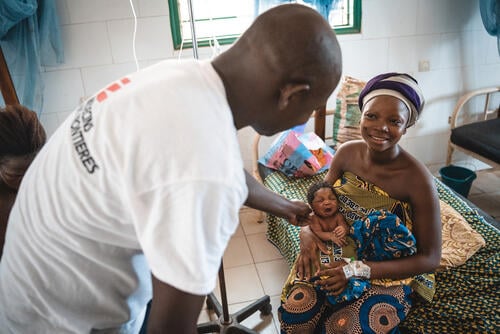
MSF gynaecologist following up with a patient in the maternity ward at Klouékanmè hospital. Benin, February 2023.
© Yves-Constant Tamomo

In southern Benin we run a maternal and neonatal healthcare programme. Meanwhile in the north, we are treating malaria in the conflict-affected department of Atacora.

Our activities in 2024 in Benin

Data and information from the International Activity Report 2024.

MSF in Benin in 2024 Médecins Sans Frontières’ key priorities in Benin are improving maternal and infant healthcare, and tackling malaria, a leading cause of death.
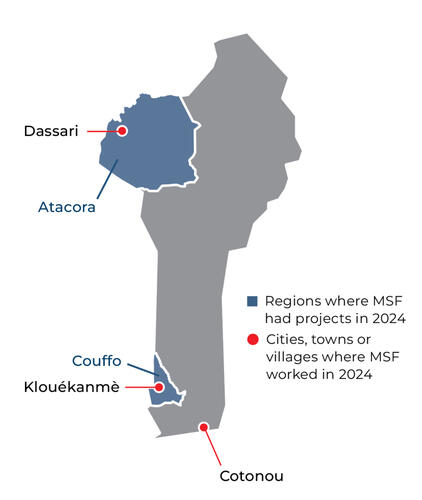
Benin IAR map 2024
Country map for the IAR 2024.
© MSF

Since 2023, we have been implementing a project in Atacora department in northern Benin to strengthen the skills of health staff and improve medical facilities, with a focus on treating malaria and responding to emergencies. 

Our teams support the Tanguiéta-Matéri-Cobly health zone – specifically the health centre in Dassari, near the border with Burkina Faso – by providing malaria treatment and nutrition support for pregnant women and children under five. In October, we extended these activities to the health centres in Matéri, Cobly, and Pétinga. This region of Benin is subject to recurrent attacks by non-state armed groups, as well as violent clashes between farmers and herders, resulting in loss of life and displacement. In 2024, we treated patients with violence-related injuries, and supported displaced people from Gouandé and Koutoucondica by distributing essential items, such as cooking equipment and hygiene kits.  

In the south of the country, the sexual and reproductive healthcare project we have been running since 2022 in the Klouékanmè-Toviklin-Lalo health zone continues to improve access to family planning services, safe abortion care, and treatment for sexual violence. In 2024, we also supported the Couffo National Blood Transfusion Authority by donating an Elisa chain, a tool used in blood tests, and setting up voluntary blood donor committees, with the aim of reducing maternal and neonatal deaths.

In addition, we launched emergency responses to assist people affected by floods in Lalo and Karimama, and by cholera epidemics in Adjahonmè and Abomey-Calavi.
 

In 2024