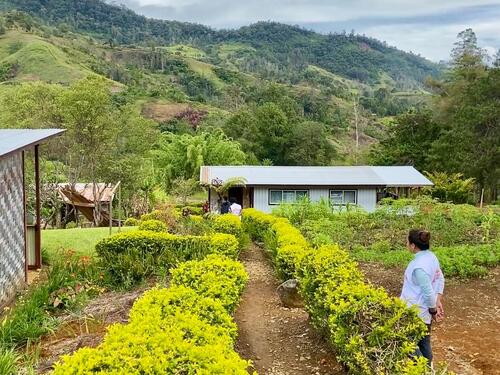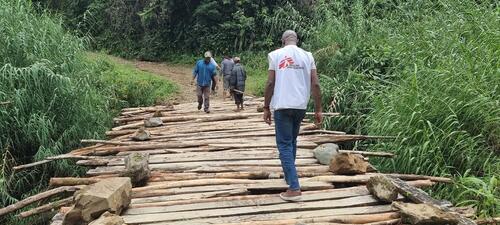
Trunk bridge, Toea, Upper Jimi, Jimi District, Jiwaka province, PNG

Papua New Guinea

At the border between Jimi and North Waghi districts, Jiwaka province. Papua New Guinea, July 2024.
© MSF

We are working to improve access to care for victims and survivors of sexual and gender-based violence, domestic violence, and violence due to sorcery accusations, in Papua New Guinea’s Highlands region.

Our activities in 2024 in Papua New Guinea

Data and information from the International Activity Report 2024.

MSF in Papua New Guinea in 2024 Médecins Sans Frontières (MSF) began a project to assist people affected by various forms of violence in hard-to-reach communities in Papua New Guinea (PNG) in 2024.
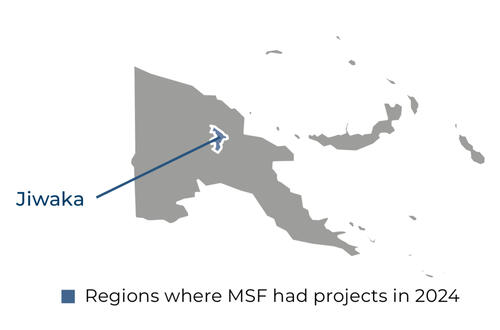
Papua New Guinea IAR map 2024
Country map for the IAR 2024.
© MSF

Access to health services for victims of intercommunal and sexual violence is uneven in the Highlands region, especially in remote areas.  With few medical facilities scattered across rugged terrain, it is difficult for rural communities in Jiwaka province to access care, leaving many without the treatment they need.

In June, in collaboration with the health authorities, MSF started setting up a project in Jiwaka, aiming to improve access to care for victims and survivors of intercommunal violence, sexual and gender-based violence (SGBV), domestic violence, election-related violence, and violence due to sorcery accusations.  

Intercommunal fighting is not unusual in PNG, especially in the Highlands region, where clans and tribes have fought each other for centuries due to land, livestock, and gender-based disputes. These fights have severe repercussions on the precarious socioeconomic situation in the Highlands, while the lack of medical care and supportive services exacerbates the suffering of both people who have been displaced by armed clashes, and the communities hosting them.  

Meanwhile, SGBV is increasing at alarming rates in PNG, especially in the Highlands region. PNG remains one of the most dangerous places in the world for women and girls. 

With this project, MSF plans to build the capacity of existing services in health facilities, develop a sustainable community-based approach to healthcare, and establish a functioning SGBV care service, by strengthening the referral and protection system.