NOVEL ALL-ORAL SHORT COURSE TREATMENT FOR DR-TB | Vladimir Regional TB Control Centre
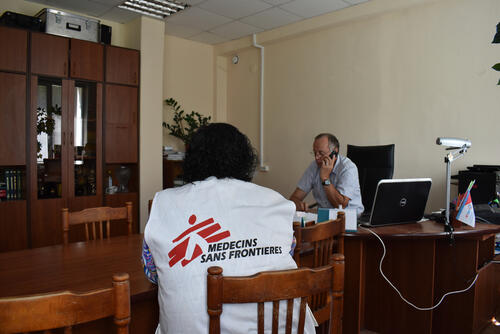
Dr Grigory Volchenkov, chief doctor of the Vladimir Regional tuberculosis control centre, and Lira Dzhaparova, MSF medical activity manager, in a meeting. Russia, August 2022.
© Alexandra Sadokova/MSF

MSF closed our programmes in Russia in 2024.

MSF worked in Russia from 1992 until August 2024. The focus of our work was providing care to people with tuberculosis.

We collaborated with health authorities and academic partners in the Arkhangelsk and Vladimir regions to reduce the burden of drug-resistant tuberculosis

Our teams also worked on a study in collaboration with the Ministry of Health, which aimed to prove the effectiveness of all-oral novel short-course regimens for patients with drug-resistant tuberculosis. In 2021, more than 60 people were enrolled into the study in the regions of Arkhangelsk and Vladimir. By the end of 2021, the first patients completed their treatment and started the follow-up stage.

In Moscow and St. Petersburg, MSF partnered with two community-based NGOs, offering healthcare to vulnerable people, including those living with HIV.

Following the escalation of the war in Ukraine in 2022, MSF provided refugees seeking safety in Russia and displaced Russians with humanitarian aid. More than 15,400 received free medical, mental health and psychosocial support.

Our activities in 2024 in Russia

Data and information from the International Activity Report 2024.

MSF in Russia in 2024 Until August 2024, Médecins Sans Frontières (MSF) ran programmes in Russia to improve treatment for patients with drug-resistant tuberculosis (DR-TB) and HIV, and assisted people displaced by the conflict in Ukraine.
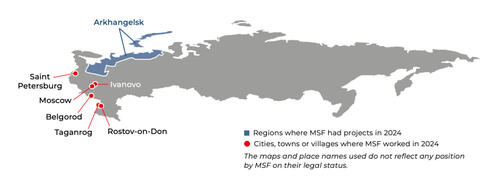
Russian Federation IAR map 2024
Country map for the IAR 2024.
© MSF

In January, we expanded the DR-TB programme we had been running in the northern region of Arkhangelsk to Ivanovo, in central Russia. Our teams provided expertise and technical assistance to the health authorities, with a special emphasis on implementing new treatment regimens, improving patients’ adherence, and integrating person-centred care into services. The aim of the collaboration was to contribute to the evidence base for more effective and less toxic treatment for DR-TB, with a view to scaling up these scientifically proven protocols across Russia.

In Moscow and Saint Petersburg, we worked with local NGOs to prevent HIV among key groups, and provide them with medical care. Urban areas in Russia attract a large number of people seeking work and income opportunities. However, individuals from vulnerable groups, especially undocumented migrants, often struggle to obtain medical care and support in big cities.

In southwestern Russia, we worked with local partners supporting people displaced by the armed conflict in Ukraine. Due to limited registration to work in Russia, we had to rely on local NGOs in the cities of Belgorod, Rostov-on-Don, and Taganrog, to ensure that people affected by the conflict received medical and mental health support. This included outpatient consultations provided by our team, as well as social support. By August, together with our partners, we had responded to the needs of thousands of people displaced from Ukraine and within Russia.

That month, we received a letter from the Russian Ministry of Justice, conveying its decision to withdraw the affiliate office of MSF in the Russian Federation from the register of affiliate and representative offices of foreign NGOs. In September, 32 years after we began working in the Russian Federation, we were forced to close our operations in the country


In 2024

Contact us

TB treatments yield promising results in the Chechen Republic