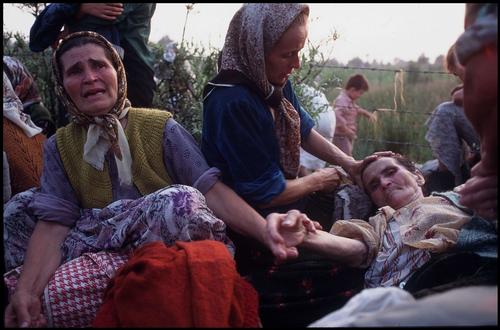
Bosnia-Herzegovina, 1995 1996
MSF Speaking Out

Humanitarian principles: How does speaking out articulate with humanitarian principles?

Refugees from the Srebrenica enclave just one day after its fall.
© Rip Hopkins

This is an interactive self-study course, which includes a learning journey. The course includes two parts:

Part 1: Thematics based on speaking out, humanitarian principles, and MSF’s working humanitarian principles.

Thematics include introductions to concepts such as: 

  • Respect for humanity and the humanitarian imperative.    
  • The normative international humanitarian framework.
  • Medical ethics including 'do no harm' and solidarity.
  • Humanitarian principles such as impartiality, neutrality, and independence, as well as some of MSF’s humanitarian principles such as accountability, and proximity.

Part 2: Case study analysis of speaking out dilemmas and humanitarian principles, with a focus on Srebrenica.

Although any of the MSF Speaking Out Case Studies could be used to teach this thematic on speaking out and humanitarian principles, the SOCS team chose the case study on MSF and the War in the Former Yugoslavia 1991-2003, (published in 2015) because of the specifics of this case, which reveal the constraints and questions associated with striking a balance between ethics, medical ethics, humanitarian principles, and speaking out - key components of the central thematic. Ethnic cleansing, crimes against humanity, and an international community that abandons the population are critical features of this war.

The Learning Journey

What you need to know before starting the course.

Thematic Concepts Module: 

  • Learning journey and expected outcomes
  • Working humanitarian principles
  • Medical ethics
  • Normative international humanitarian framework
  • Limitations and challenges: Speaking out and humanitarian principles 

Case Study Module: 

  • Introduction to the case study
  • MSF and the war in the Former Yugoslavia 
  • MSF and Srebrenica including after-action analysis 
  • Epilogue
  • Wrap up and next steps

Quiz and credentialing  


Approximately 4 to 6 hours.
 

  • For optimal results, the recommended learning path is to first complete the foundational initial module, no matter your level of seniority or responsibility and then proceed to the 2-part course of your choice.
  • The topics are complex so plan to work over several sessions instead of all at once.
  • Work at your own pace.
  • Knowledge checks and evaluations are provided to assist in highlighting essential information. 
  • A learning journal is provided with reflection questions.
  • Suggested readings are provided at the end of each section if you want to explore particular topics further.
  • To receive the course badge and certificate, please complete all course modules listed above.
  • A quiz score of 70% or better is required.
  • Upon completion of the quiz, you will be able to access your credentials.

By the end of this course, you should gain the following competencies:

Knowledge competencies:

  1. Understand how speaking out supports (and sometimes creates tension and trade-offs with) the humanitarian concepts that comprise the foundation of MSF’s work.
  2. Understand speaking out in MSF and the normative international framework for humanitarian action, including international law.

Skills Competencies

  1. Apply critical reflective processes to speaking out dilemmas.
  2. Identify, compare, and analyse some of the dilemmas highlighted in the SOCS.
  3. Apply critical thinking & leadership skills to real-life contemporary dilemmas.

How to enrol


All students - internal and external - must register on TEMBO, the MSF learning platform, in order to access courses. Click on the button below to access the platform.

Return to Course Home