


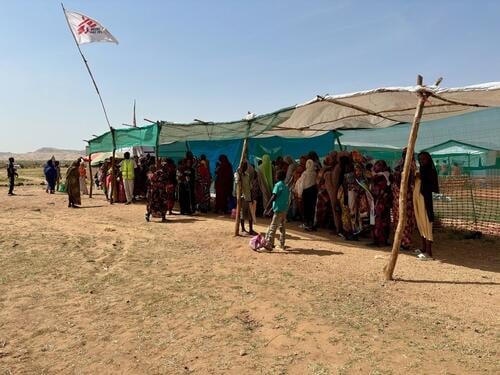
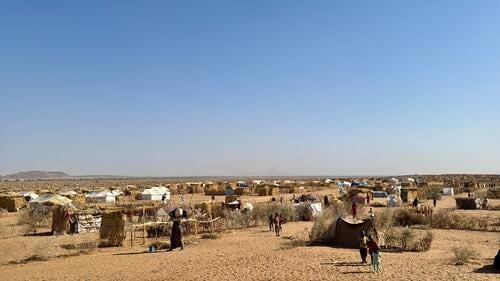
- Our teams working in Tawila, Sudan, fear that many people are trapped in El Fasher, a city located 60 kilometres away, where atrocities and killings are taking place.
- In Tawila, we are seeing high numbers of people with malnutrition, including men and children, as well as people with gunshot injuries.
- People must be allowed to escape El Fasher and move to safer areas.
Paris - Médecins Sans Frontières (MSF) denounces the horrendous mass atrocities and killings, both indiscriminate and ethnically targeted, that have taken place this week in and around El Fasher, Sudan. We reiterate our fear that large numbers of people remain in grave danger and are being prevented by the Rapid Support Forces (RSF) and its allies from reaching safer areas, such as Tawila, where we work.
Our teams in Tawila prepared to cope with a mass influx of displaced and injured people when El Fasher, the capital of North Darfur state and located 60 kilometres away, was seized by the RSF on 26 October, after 17 months of a suffocating siege and attacks. In recent months, waves of people fled to Tawila after each major escalation of violence in El Fasher, which, according to the UN, was still home to 260,000 people, as of late August. 1
However, over the past five days, just over 5,000 people managed to make their way to Tawila according to aid agencies on the ground. 2 They describe massacres and spoke of people who remain stranded and are being subjected to torture, kidnappings for ransom, sexual violence, and summary executions in El Fasher, neighbouring towns, and along escape routes.
The arrival numbers don’t add up, while accounts of large-scale atrocities are mounting. Where are all the missing people who have already survived months of famine and violence in El Fasher?Michel Olivier Lacharité, MSF head of emergencies
“The arrival numbers don’t add up, while accounts of large-scale atrocities are mounting. Where are all the missing people who have already survived months of famine and violence in El Fasher?” asks Michel Olivier Lacharité, MSF head of emergencies.
“Based on what patients tell us, the most likely, albeit frightening, answer is that they are being killed, blocked, and hunted down when trying to flee,” he says. “We urgently call on the RSF and its allied armed groups to spare civilians and allow them to reach safety. We also urge all diplomatic stakeholders, including the ‘Quad’ comprising the US, Saudi Arabia, the UAE, and Egypt - to use their leverage to stop the bloodbath.”
Between 26 and 28 October, new arrivals from El Fasher, mostly women, children and elderly people with catastrophic levels of malnutrition, were brought by truck. Others, including gunshot victims, travelled on foot, hiding during daytime and trekking at night to avoid armed men on the main roads.
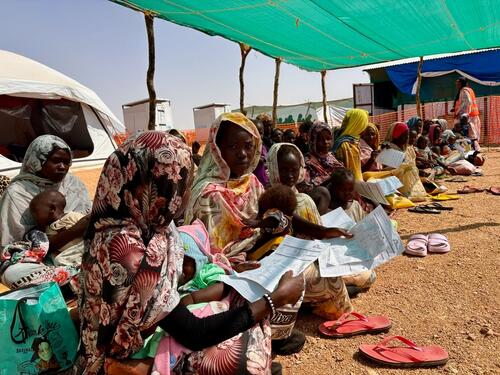
Among new arrivals on 27 October, every single one of the 70 children under five years old were acutely malnourished, with 57% of them suffering from severe acute malnutrition. The following day, our team screened 120 men arriving from El Fasher, with 20% suffering from severe acute malnutrition.
These shocking indicators point to the sheer agony people are enduring in El Fasher and surrounding camps. The area was declared as undergoing famine more than a year ago and has since then been increasingly cut off from food and lifesaving supplies, with people relying on animal feed to survive.
Several eyewitnesses told MSF of a group of 500 civilians, as well as soldiers from the Sudanese Armed Forces and Joint Forces, who attempted to flee on 26 October, only for most to be killed or captured by the RSF and its allies. Survivors report individuals being separated by gender, age or perceived ethnic identity, with many remaining held for ransom, with sums ranging from 5 million to 30 million Sudanese pounds (€7,000 to €43,000).
One survivor said he paid 24 million Sudanese pounds (€34,000) to his captors to save his life and escape. Another reported extremely gruesome scenes of fighters crushing several prisoners with their vehicles.
Given the state of people who escaped and made it barely alive to Tawila, it’s clear that they are in urgent need of medical and nutrition care, psychosocial assistance, shelter, water, and humanitarian assistance in general.Dr Livia Tampellini, MSF’s deputy head of emergencies
“Between 26 and 29 October, we’ve received 396 injured people and treated over 700 new arrivals from El Fasher in a dedicated hospital emergency room,” says Dr Livia Tampellini, MSF’s deputy head of emergencies. “The main injuries of patients currently being treated at the hospital are gunshot wounds, fractures, and other injuries linked to beatings and torture.”
“Some suffer from infected wounds or complications of surgical procedures already performed in El Fasher amid desperate conditions with virtually no access to medical supplies and drugs,” says Dr Tampellini.
MSF set up a health post at the entrance to Tawila, whilst scaling up the provision of emergency care, surgical care, and other medical services at the hospital. Most of our Sudanese staff in Tawila have relatives who were killed in El Fasher over the week. Displaced people already present in the town go to meet new arrivals in the hope of recognising a familiar face among the starving and traumatised people or seeking news of their missing relatives.
“Given the state of people who escaped and made it barely alive to Tawila, it’s clear that they are in urgent need of medical and nutrition care, psychosocial assistance, shelter, water, and humanitarian assistance in general,” says Dr Tampellini. “There is no more time to waste to help other survivors, they need to be allowed to move to safer areas and get lifesaving assistance.”
Conflict in Sudan
Strike on Al‑Jabalain hospital results in 10 fatalities, including seven medical staff
Voices from the Field
2 Apr 2026
Conflict in Sudan
MSF report finds there are no safe places for women and girls in Darfur
Press Release
31 Mar 2026