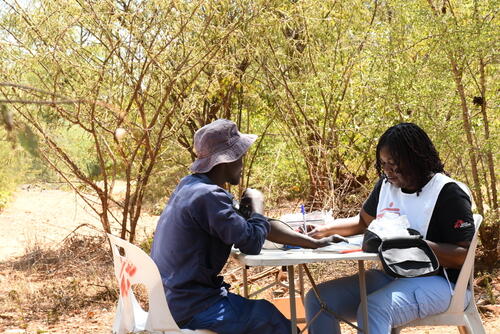
treatment during outreach

Zimbabwe

An MSF nurse assists and checks the blood pressure of a patient. Zimbabwe, March 2024.
The economic situation continues to decline with very little funds available for public expenditure and social services. As a result, the health sector faces numerous challenges, including shortages of medical supplies and essential medicines.

We run projects in partnership with the Zimbabwean Ministry of Health and Child Care (MoHCC), that include treatment and care for people living with HIV, health programmes for migrants, adolescent sexual and reproductive health and environmental health.

Under the health programme for migrants in Beitbridge, MSF teams offer medical assistance to migrants and deportees according to their specific health needs. In Tongogara Refugee Camp, we provide refugees and asylum seekers with mental healthcare.

We also offer comprehensive sexual and reproductive healthcare services for adolescents in the urban districts of Mbare and Epworth and support the health ministry to respond to disease outbreaks.

Our activities in 2024 in Zimbabwe

Data and information from the International Activity Report 2024.

MSF in Zimbabwe in 2024 In 2024, Médecins Sans Frontières (MSF) continued supporting the response to a nationwide cholera outbreak in Zimbabwe, the second largest in the country’s history, and addressed gaps in healthcare.
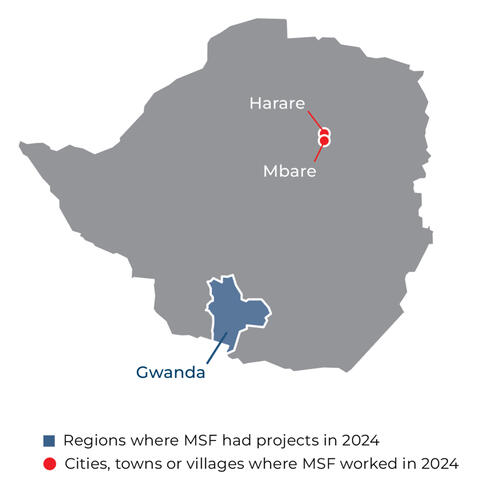
Zimbabwe IAR map 2024
Country map for the IAR 2024.
© MSF

MSF supported the Zimbabwean Ministry of Health and Child Care’s response to cholera with a range of activities, comprising treatment, donations of medical supplies, infection prevention and control measures, logistics, water and sanitation activities, and awareness-raising sessions in both urban and rural areas. We had teams working in Harare, Epworth, Mazowe, Mbare, Hwange, Shamva, Kadoma, Kariba, Sanyati, and Chitungwiza. The outbreak lasted for 18 months, and affected people across 10 provinces.

In Harare, we continued to offer comprehensive sexual and reproductive healthcare for adolescents and young people in Mbare and Epworth. Our services included mental health support, testing, treatment and counselling for HIV and sexually transmitted infections (STIs), family planning, and ante- and postnatal consultations.  

To encourage participation in decision-making and to ensure that our services align with adolescents’ and communities’ health needs and realities, MSF established an adolescent advisory board. We set up a variety of communication channels, such as suggestion boxes in all healthcare facilities, WhatsApp and SMS messaging, and peer consultations, to strengthen patient feedback systems. We also launched community campaigns to raise awareness of patient rights, and conducted satisfaction surveys to gather critical insights into patient experiences and gaps in services.  

In Gwanda district, Matabeleland South, we ran mobile clinics to serve small-scale artisanal miners and their communities. Due to rigorous screening and treatment efforts, we saw a reduction in STIs among the miners in 2024. We also screened miners for silicosis and tuberculosis, and all eligible women around the mines for cervical cancer. In addition, we provided family planning services to the mining community, which included introducing a more effective injectable contraceptive method called Sayana Press. We also collaborated with the Ministry of Health and Child Care in mass drug administration campaigns for lymphatic filariasis, the provision of a variety of basic health services, and paediatric vaccination programmes.


in 2024