Still_Horizontal_Scene 2
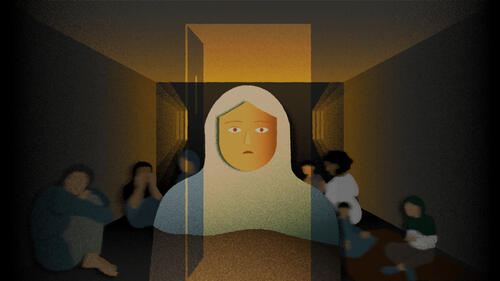
Illustrations depicting the testimony of a survivor of detention in Syria, July 2025.

New MSF programme treats survivors of detention in Syria

Illustrations depicting the testimony of a survivor of detention in Syria, July 2025.

While arbitrary detention was a longstanding practice in Syria, it grew more common during the nearly 14-year-long civil war. People were kept in dark cells, unaware of why they were detained, what happened to their families, and if they would ever be released. They could spend years being subjected to ill treatment under custody, without a trial or investigation. 

This changed in December 2024, when the fall of the former Syrian government led to the opening of prison gates. As survivors left detention centres, it was evident they needed medical treatment for all they had suffered, including systematic abuse, neglect, and torture.

“I was taken to solitary confinement while my daughters were locked in another cell. I knew nothing about them,” says Suha*, a 50-year-old woman who was detained in 2018 without charge and held for six years. “I didn’t care about the beatings I took, hoping that when the beating stopped, I would find out the fate of my daughters.”

Suha, like hundreds of prisoners and detainees, was granted her freedom and came out of prison at the end of 2024. Many survivors spent years in detention under harsh conditions. They were deprived of proper food and medical care, and exposed to endless cycles of physical and psychological ill treatment, as reported to Médecins Sans Frontières (MSF) medical and mental health teams. 

Suha spent six years being transferred from one cell to another. Her longing for freedom never waned, before, during, or after her detention. She narrates her story in MSF’s clinic in Damascus, Syria.

“During the war in Syria, we saw the youth arrested before our eyes. Some of them were returned in body bags, some of them never returned. I had a feeling my turn was coming. Participating in protests, demanding freedom, was my sin.

One ‘report’ was enough to strip me of whatever freedom I had for six years. I was arrested along with my six daughters and granddaughter who had not yet turned one. They said, ‘two hours and we will return you,’ as we got closer to Mezzeh tunnel in the capital Damascus - that tunnel that had absolutely no light at its end.

I was taken to solitary confinement while my daughters were locked up in another cell. I did not know what was happening to them. All I knew during that period was the cold, the horror, and the number of tiles in my cell.

When the time for investigation came, my heart thumped. I did not care about the beatings I took, hoping that when the beating stopped, I would find out the fate of my daughters. But as soon as they opened their mouths, they threatened my family’s safety if I did not confess everything. They convinced me that no one would care about us, that nothing would stop them from hurting my daughters other than the “truth.”

I went back to solitary, then back to interrogation, a never-ending whirlpool. One time when I was in my cell, I heard them from behind the door talking about one of my daughters, a minor, that something bad happened to her. “Is the girl bleeding? Take her to the doctor.” In the investigation room, they led the conversation about this bad thing until I started imagining one of those men undressing my daughter.

I did not know if it was a mere threat. I did not know just how far they could go. At that moment, it was like I dissociated. I became a pile of anger and tears. I started answering his questions mindlessly, spitting out the scenario he thinks is the truth. Then he asked me, “Why all this meltdown? We would not do that.” But how could I believe him before I saw my daughter?

They brought her to me. She was fine, this time. After that, they changed their tone with me, getting me to a false sense of security. I wished they would beat me instead of torturing me psychologically. I spent 13 days straight in my cell, stealing glances of my daughters’ feet from under the door when they would go to the toilets facing my cell. I would count the minutes for seven hours between these moments to see that they were still alive.

Then they put me and my daughters in one cell for six months. I was able to embrace them, trying to make it all seem okay, even when I had nothing to say or when nothing was okay. I would shiver in the darkness of the cell, that never-ending night, but I tried as much as possible not to let my daughters feel it. I slept closer to the door to make them feel a bit safe. I would give anything, even my life, to keep them safe.

They would offer us food that had nothing to do with food: a barely cooked soup, some potatoes that started rotting. I was seeing my daughters wither in front of my very eyes. I am their mother, but I could not take care of them. I could not feed them what would give them energy to handle another day of pain.

But they took them from me again. They convinced me that I was not fit to raise them, then they transferred them to an orphanage. I was hoping they would be in a better place, but my heart was torn apart. Who is going to love them more than I do? But the truth was that we were transferred to different prisons. When one of the prisoners told me that communication between both prisons was possible, I demanded to talk to my daughters. For three months, we communicated for minutes, which I would long for day and night.

They told us that my daughters will be held for not snitching on their father. They threw them in a juvenile detention centre. They deprived me of even looking at them for a year and eight months. In the end, my daughters were released.

During the years of my detainment, I was promised that I would be released many times, but they took me back every time. As soon as a security branch was done with me, another took over. I would start the whole process of pain all over again, between bloody interrogations, severe beatings, and psychological torture. I saw the sun briefly. I never saw the sky except through barbed wire.

I often think of revenge. Abnormal reactions to normal actions have become my norm. I do not want feelings of hatred and bitterness to overcome me. It hurts me and not other people. I would like to rid myself of all that my experience left in me.”

Suha has opened a small business selling dresses in her neighbourhood. She is helping her daughters move on with their lives, while trying to restart her life for their sake.

Suha is following up with MSF’s mental health team at the survivors of ill treatment clinic in Damascus. By doing that, she is following up on her journey to freedom, this time from the darkness of the past.


In response to their huge medical and mental health needs, MSF teams launched a programme for survivors of ill treatment in Syria. The programme was piloted in MSF’s existing project in Idlib governorate. MSF then opened a dedicated clinic in Damascus, located inside Al-Mujtahid hospital, and later introduced the programme in Kafr Batna in eastern Ghouta, where most of our patients come from. The area was historically an opposition area, and was besieged and heavily bombarded.

The clinic for survivors of ill treatment offers general medical consultations with referrals to specialised care, psychosocial support, and social work services which link patients to non-medical assistance through local organisations and associations who offer support beyond the scope of MSF’s services.

“The mental health ramifications of detainment in Syria are quite alarming,” says Laura Guardiola, MSF’s medical adviser in Damascus. “Being detained under unimaginable conditions of ill treatment that amount to physical and psychological torture has left deep and lasting wounds on former detainees and prisoners: wounds that require time, support, and care to begin healing.” 

Being detained under unimaginable conditions of ill treatment that amount to physical and psychological torture has left deep and lasting wounds on former detainees and prisoners: wounds that require time, support, and care to begin healing. Laura Guardiola, MSF’s medical adviser in Damascus

MSF is working on reaching more women, as the low number of female patients in our cohort is worrying. Even fewer children are seeking treatment. Less than 15 per cent of the consultations were with a female patient in the first two months of the clinic’s activities in Damascus. Several female former detainees have survived sexual violence during detention, which might prevent them from seeking support, mainly due to stigma.

While people left the security branches and prisons where they were detained, they are reminded of their horrific experiences in their daily lives, which makes reintegration in society challenging. Suha talks about how she will never forget the Mezzeh tunnel in Damascus, which is where she realised she was not going to be returned to her home unharmed. 

“That tunnel absolutely had no light at its end,” she says. “I often think of revenge. Abnormal reactions to normal actions have become my norm. I do not want feelings of hatred and bitterness to overcome me. I would like to rid myself of all that my experience left in me.”

Suha is one of 113 patients in our cohort of survivors of ill treatment across the three locations. She is following up with our survivors of ill treatment team, and though there will be a long road ahead, she is beginning to heal from all she was subjected to. Our team believes her strong will to live, though shaken during her detention, never went away, and she is restarting her life for the sake of her daughters. 

*Name changed.
Up Next
Syria
Project Update 5 February 2026